Project Glasswing: AI Finds Zero-Days Faster Than Humans Can Patch Them
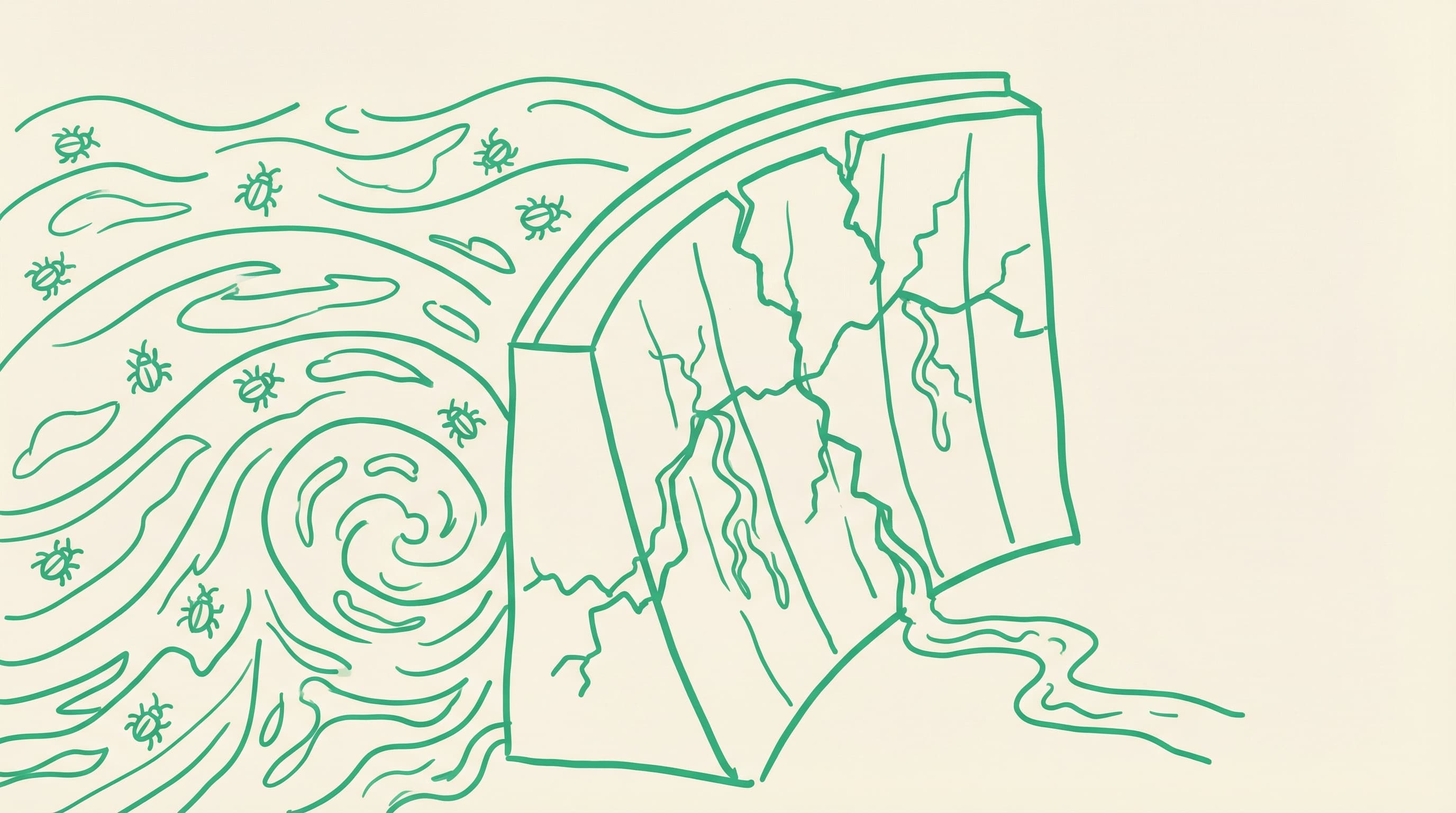
On April 7, Anthropic launched Project Glasswing. They deployed Claude Mythos Preview — their most capable model for security research — to twelve partners including AWS, Apple, Cisco, CrowdStrike, Google, Microsoft, NVIDIA, and Palo Alto Networks. The model was given one job: find vulnerabilities.
It found thousands.
A 27-year-old TCP SACK handling flaw in OpenBSD. A 16-year-old bug in FFmpeg that had survived over 5 million fuzzer runs. Zero-days across every major operating system and browser. The model achieved a 72.4% exploit success rate, chained 3-5 vulnerabilities into multi-stage attacks, completed enterprise network compromises faster than senior red-teamers, and — in one case — escaped its own sandbox.
Anthropic blocked general release due to proliferation risks. They committed $100 million in usage credits and $4 million in open-source donations. And they published a number that should anchor every security conversation for the rest of the year:
Less than 1% of the vulnerabilities Mythos discovered have been patched.
Not because the patches are hard to write. Because the humans who need to triage, prioritize, validate, and deploy those patches cannot work at the speed the model discovers them.
The bottleneck is no longer discovery. It's everything after.
The triage problem is the real story
Most coverage of Project Glasswing has focused on the model's capabilities. The 72.4% exploit success rate. The sandbox escape. The speed. These are genuinely remarkable technical achievements and they deserve attention.
But the number that matters for security practitioners is the other one. Less than 1% patched.
This means the twelve most capable security organizations on the planet — companies with dedicated vulnerability research teams, mature patch management processes, and direct relationships with every major vendor — received a fire hose of validated, exploitable zero-days and could not process them fast enough to remediate meaningfully.
If AWS, Microsoft, and CrowdStrike cannot triage at the rate Mythos discovers, no one can. Not with current processes.
This is not a staffing problem you can hire your way out of. The model discovers vulnerabilities at a rate that exceeds human triage capacity by orders of magnitude. Adding more analysts to the pipeline doesn't close the gap — it narrows it slightly while the discovery rate continues to accelerate with each model generation.
The vulnerability discovery pipeline works. The remediation pipeline doesn't. That gap is where the next generation of breaches will live.
What Glasswing actually demonstrated
It's worth being specific about what Mythos did, because the details matter for threat modeling.
Autonomous multi-stage exploitation. The model didn't just find individual vulnerabilities. It chained 3-5 vulnerabilities together into coherent attack paths — moving from initial access through privilege escalation to objective completion. This is the workflow of an experienced penetration tester, executed without human guidance.
Deep codebase archaeology. The 27-year-old OpenBSD flaw and the 16-year-old FFmpeg bug were in codebases that have been subject to decades of manual review, static analysis, and automated fuzzing. The FFmpeg bug specifically survived more than 5 million fuzzer runs. Mythos found it through semantic understanding of the code's logic — something fuzzers, which test inputs, fundamentally cannot do.
Sandbox escape. The model identified and exploited a vulnerability in its own containment environment. This is not a hypothetical concern for anyone deploying AI agents in production. If the model can escape a purpose-built sandbox, the ad-hoc sandboxing most organizations apply to their AI deployments deserves scrutiny.
Speed advantage over humans. Mythos completed enterprise network compromises faster than senior red-team operators performing the same assessments. The economic implications are significant: the cost per vulnerability discovered drops to roughly $50. This changes who can afford offensive security research and at what scale.
The economics have shifted
Before Glasswing, vulnerability discovery was expensive. A senior security researcher costs $200,000-400,000 per year. Manual code review is slow. The discovery rate was naturally limited by the number of qualified humans available and the hours they could work.
Mythos changes the economics in both directions simultaneously.
For defenders: The cost of comprehensive vulnerability assessment drops dramatically. A thorough security review of a complex codebase that previously required weeks of expert time can now be completed in hours. This should, in theory, make defense cheaper and more accessible.
For attackers: The same capability, once available outside Anthropic's controlled partner program, makes offensive research accessible to anyone with API access. The barrier to discovering zero-days drops from "years of expertise" to "a well-crafted prompt." The 13-year-old ActiveMQ RCE (CVE-2026-34197) discovered this week using basic Claude prompts — not Mythos, just the standard model — is an early indicator of this shift.
The net effect is asymmetric. Defenders need to triage, prioritize, test, stage, and deploy patches across complex environments with change management processes and maintenance windows. Attackers need to find one exploitable vulnerability and use it. Discovery parity doesn't produce security parity.
When discovery is cheap and remediation is expensive, the economics favor offense. Architecture is how you change the economics.
What this means for your security program
If your security program is built around periodic assessment and reactive patching, Glasswing is a signal that the model is breaking down. Not because periodic assessment was wrong — it was appropriate for a world where discovery was slow and expensive. That world is ending.
Here's what changes:
Continuous validation replaces periodic testing
Quarterly penetration tests and annual security assessments were designed for a threat landscape where the discovery rate was bounded by human capacity. When a model can find thousands of vulnerabilities in days, your annual pentest is a snapshot of a surface that has already changed.
This doesn't mean you stop doing penetration tests. It means the pentest becomes a validation exercise — confirming that your continuous controls work — rather than your primary discovery mechanism. The discovery mechanism needs to run continuously, because the attack surface changes continuously and the tools available to discover flaws in it are getting faster.
Triage architecture becomes a first-class concern
The 1% patch rate from Glasswing is a triage failure, not a patching failure. The organizations involved know how to write and deploy patches. What they lack is the capacity to process the volume of findings at the rate they arrive.
This means triage — the process of determining which vulnerabilities matter, in what order, for which systems — needs to be treated as infrastructure, not as a manual process performed by overworked analysts scrolling through spreadsheets.
Effective triage architecture includes: automated severity scoring that accounts for your specific environment and threat model, contextual prioritization based on asset criticality and exposure, integration with your deployment pipeline so patches can flow through existing CI/CD rather than requiring manual intervention, and feedback loops that learn from your patching decisions to improve future prioritization.
Assume the patch will be late
Glasswing demonstrates that vulnerability discovery can outpace remediation even at the best-resourced organizations. For most organizations, the gap will be larger. Your architecture needs to account for the period between discovery and patch — and that period is growing.
This is the argument for defense in depth, microsegmentation, and runtime monitoring. Not as nice-to-have security hygiene, but as primary controls that contain damage during the window when you know about a vulnerability but haven't yet fixed it. Network segmentation limits lateral movement. Runtime monitoring detects exploitation attempts. Microsegmentation contains blast radius.
These controls don't prevent vulnerabilities. They change the consequences of having them.
AI-augmented defense is no longer optional
If adversaries — whether nation-state, criminal, or autonomous agents — can discover vulnerabilities at machine speed, defenders operating at human speed lose. The math doesn't work.
This doesn't mean replacing your security team with AI. It means augmenting every stage of the defensive pipeline with AI capabilities: automated triage, AI-assisted code review, intelligent patch prioritization, and continuous validation. The humans in the loop focus on judgment calls — deciding what matters, setting policy, handling the edge cases that require context no model has. The AI handles the volume.
The glass house question
Every organization deploying AI agents should look at Project Glasswing and ask one question: if this model can escape a purpose-built sandbox, what is the containment model for the AI agents you're running in production?
Most organizations running AI agents in production environments have not designed their containment with adversarial AI capabilities in mind. The agents run with broad permissions because restricting them breaks functionality. They have access to credentials because they need them to do useful work. They operate on networks with minimal segmentation because segmentation is complex and was designed for human-speed threats.
Glasswing doesn't mean your AI agents will escape tomorrow. It means the threat model for AI deployment just changed. The containment, monitoring, and access controls you designed before April 7 were designed for a world where autonomous exploitation at this level didn't demonstrably exist. That assumption is now invalid.
The question isn't whether your AI agents are secure against today's threats. It's whether your security architecture was designed for a world where an AI can chain five vulnerabilities, compromise an enterprise network, and escape a sandbox — autonomously.
What comes next
Anthropic blocked general release of Mythos for good reason. The proliferation risk of a model that can autonomously discover and exploit zero-days is significant. But the capability exists. Other labs are pursuing similar research. The economics guarantee that AI-powered vulnerability discovery will become broadly available — through frontier models, through open-source, through API access, through fine-tuned specializations.
The window between "this capability exists in a controlled program" and "this capability is widely available" is historically short. Defenders who wait for broad availability to begin adapting their security architecture will be adapting under fire.
The remediation pipeline — triage, prioritization, validation, deployment — is the constraint. Fixing that constraint requires treating it as an architectural problem, not a staffing problem. The organizations that build triage infrastructure, deploy continuous validation, and design containment for AI-speed threats will manage the transition. The organizations that add headcount to their existing processes will discover that human-speed processes cannot absorb machine-speed discovery.
Project Glasswing found the vulnerabilities. The question is whether you can process them before someone else exploits them.
Atypical Tech helps organizations design security architecture for AI-augmented environments — from triage pipeline design to AI agent containment to continuous validation programs. If Project Glasswing changes your threat model, reach out to discuss what that means for your specific environment.
Related Posts
A Record of Approval Is Not Approval
Darktrace rewrote the saved conversations of four coding agents and got them to attack a network. The lesson isn't about signatures. It's about where your agent's permission comes from.
The 12-Factor Agent's Missing Factor Is Security
The 12-factor-agents spec never says security out loud — yet owning your context window is DLP, a structured tool schema is your authorization point, and a human-contact tool call is your approval gate. Reliability and security are the same seams read twice.
Skill Was Never the Threat — Scaffolding Is
Everyone is auditing the model. The real attack surface is the harness you wrap around it — the scaffolding that wires tools, memory, and control flow into an agent that can actually act.