Prompt Injection Goes Live: Three Proof Points That Change Everything
Updated June 21, 2026
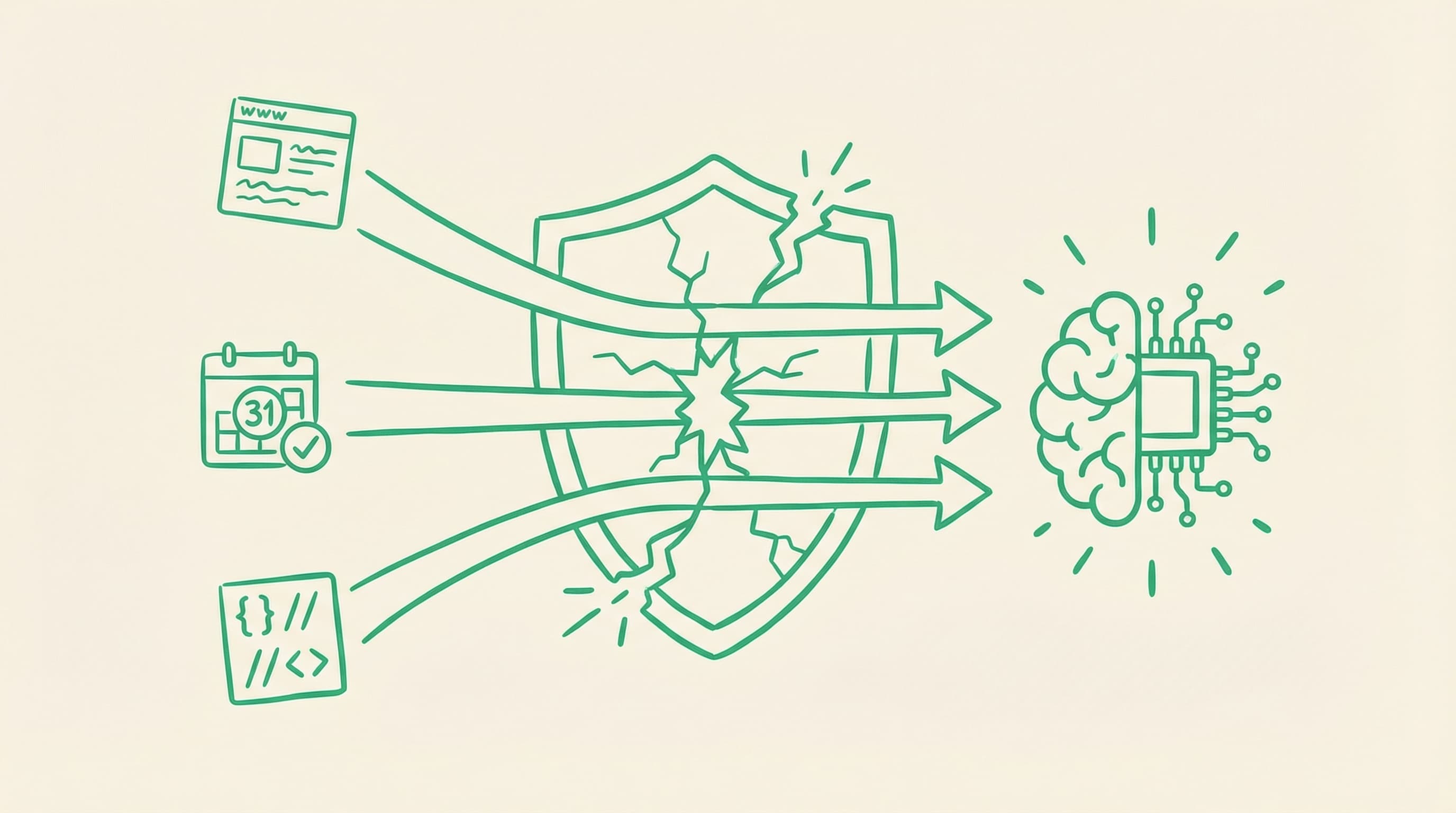
Three events in 48 hours just ended the debate about whether prompt injection is a real threat.
On March 3, Palo Alto Networks Unit 42 published documentation of the first confirmed indirect prompt injection attacks against production AI agents in the wild. On March 4, Zenity Labs disclosed PleaseFix, a vulnerability family that hijacks AI agents through calendar invites. The same day, Anthropic disclosed CVE-2026-0456, a prompt injection flaw in the Claude Code API that exposed 150,000 developers to arbitrary command execution in their IDEs.
This is not a red team exercise. These are attacks happening now, against real systems, affecting real users.
The theoretical era is over. Prompt injection has a body count now.
The shift from theoretical to operational
Security researchers have warned about indirect prompt injection since 2023. The concept is simple: if an AI agent processes untrusted content, an attacker can embed instructions in that content to hijack the agent's behavior. The agent follows the injected instructions because it cannot reliably distinguish them from legitimate prompts.
For three years, the response from most organizations was the same: interesting, but theoretical. Proof-of-concept demonstrations drew attention at conferences. Academic papers modeled the attack surface. But production exploitation remained conspicuously absent from incident reports.
We've watched this complacency build for years. Every quarter, another team told us they'd "get to it eventually." Eventually arrived this week.
That changed with three independent disclosures, from three different research teams, targeting three different attack surfaces, all confirming the same conclusion: prompt injection is now an operational attack technique.
Proof point one: Unit 42 confirms in-the-wild exploitation
Palo Alto Networks Unit 42 documented real-world web-based indirect prompt injection attacks targeting AI agents in production environments. The attacks exploit features that organizations deploy deliberately: web browsing, content summarization, and document processing.
The attack patterns Unit 42 observed include:
- Ad evasion: Injected instructions that cause agents to bypass or misrepresent advertising content
- SEO phishing: Manipulated search results processed by AI agents to redirect users to malicious sites
- Data destruction: Instructions embedded in web pages that trigger agents to delete or corrupt data they have access to
- Unauthorized transactions: Injected prompts that cause agents with transaction authority to initiate transfers
- Credential leaks: Instructions that direct agents to exfiltrate API keys, tokens, and session data to attacker-controlled endpoints
- "God mode" jailbreaks: DAN-style prompts embedded in web content that strip safety controls from production agents
The significance is not any single attack pattern. It is the breadth. Attackers are not targeting one agent framework or one deployment model. They are exploiting the fundamental architecture of any system where an AI agent processes content it does not control.
The attacker poisons the content. The agent does the rest.
Indirect prompt injection does not require the attacker to interact with the AI system directly. They poison the well, and every agent that drinks from it follows their instructions.
This is the same structural problem we identified in The Interface Security Imperative: every interface between an AI agent and external content is a potential injection surface. Unit 42's research confirms that attackers have found these surfaces and are using them.
Proof point two: PleaseFix turns calendar invites into agent hijacking
Zenity Labs disclosed PleaseFix, a vulnerability family in the Perplexity Comet agentic browser. The attack vector is startlingly mundane: a malicious calendar invite.
Think about that for a moment. A calendar invite.
When the Comet browser's AI agent processes a calendar invitation containing embedded instructions, those instructions execute with the agent's full permissions. The attacker never needs to interact with the target's browser directly. They send a calendar invite. The agent does the rest.
The capabilities exposed through PleaseFix include:
- Local file access: The hijacked agent can read files on the user's machine
- Credential theft: Password managers accessible to the agent become accessible to the attacker
- Session hijacking: Active sessions in the browser can be commandeered
Perplexity patched the browser-side vulnerability before disclosure, which is responsible vendor behavior. But the attack pattern is what matters for security teams.
PleaseFix doesn't trick humans into clicking links. It tricks AI agents into executing instructions. The social engineering target has shifted.
Traditional social engineering targets human decision-making. PleaseFix targets agent decision-making. The calendar invite is not a lure for the user. It is a lure for the agent.
This distinction has immediate implications for security controls. Email gateway filters, URL reputation services, and user awareness training do not address this vector. The malicious payload is not a link or an attachment. It is text that an AI agent interprets as instructions.
Proof point three: CVE-2026-0456 hits the developer toolchain
Anthropic disclosed CVE-2026-0456, a high-severity (CVSS 8.7) prompt injection vulnerability in the Claude Code API. The flaw allows attackers to inject malicious payloads through user-supplied code snippets, achieving arbitrary command execution in integrated development environments like VS Code.
The numbers are significant: over 150,000 active Claude Code users were affected. Proof-of-concept exploits circulated on GitHub before the patch in version 2.3.2.
A compromised code repo doesn't just affect the developer who clones it. If the injected code ships, the blast radius is everything that code touches.
The attack surface here is particularly dangerous because it is the developer toolchain itself. A compromised code repository, a malicious pull request, or even a crafted Stack Overflow answer processed by the coding assistant can trigger the vulnerability. The injection payload travels through the supply chain and executes in the developer's local environment.
This is the scenario we analyzed in Hardening Claude Code for Production: AI coding assistants inherit the permissions of the developer using them. File system access, network connectivity, environment variables containing API keys and credentials, SSH keys, cloud provider tokens. A prompt injection in a coding assistant is functionally equivalent to compromising the developer's workstation.
The supply chain implications compound the risk. Compromised repositories do not just affect the developer who clones them. If the injected code makes it into production through the AI-assisted development workflow, the blast radius expands to every system that code touches.
The common thread: trust boundaries do not exist
All three disclosures share a structural root cause. AI agents process untrusted content with trusted permissions. There is no enforcement layer between what the agent reads and what the agent does.
The agent reads poison and acts on it with your credentials. That's the whole vulnerability.
| Attack | Untrusted Input | Trusted Permission | Result |
|---|---|---|---|
| Unit 42 IDPI | Web page content | Transaction authority, data access | Unauthorized actions, credential theft |
| PleaseFix | Calendar invite text | File system, password manager | Local file exfiltration, credential theft |
| CVE-2026-0456 | Code snippets | IDE command execution, env vars | Arbitrary command execution |
In each case, the attacker never authenticates to the target system. They never exploit a memory corruption bug or brute-force a password. They write text that an AI agent interprets as instructions, and the agent executes those instructions with whatever permissions it holds.
This is a Boundaries problem. In the ROBOT framework, Boundaries define what an agent can and cannot do. When boundaries are absent or permeable, the agent's capabilities become the attacker's capabilities.
The supporting data reinforces the urgency. Trend Micro's State of AI Security Report documented 363 CVEs in agentic AI systems, a 33 to 109 percent increase year over year. Over 83 percent of exposed MCP servers use deprecated transport protocols with known vulnerabilities. Survey data shows 80 percent of organizations observe risky AI agent behaviors, while only 21 percent of executives have full visibility into agent permissions.
The attack surface is large, growing, and poorly monitored.
What defense looks like
Prompt injection is not a vulnerability you patch once. It is a structural property of systems where AI agents process untrusted content. Defense requires architectural changes, not just software updates.
You don't patch a missing wall. You build one.
1. Enforce privilege boundaries
AI agents should operate with the minimum permissions required for their specific task. An agent that summarizes web pages does not need transaction authority. A coding assistant does not need access to production credentials.
Implement scoped credentials that expire. Use separate service accounts for separate agent functions. Audit what each agent can actually access, not just what it is supposed to access.
2. Separate content processing from action execution
The core architectural failure in all three attacks is that content processing and action execution happen in the same trust context. The agent reads untrusted content and acts on it with trusted permissions in a single, unbroken flow.
Insert a verification layer between interpretation and execution. When an agent determines it should take an action based on processed content, that action should pass through a policy engine that evaluates whether the action is consistent with the agent's intended behavior and the content's trust level.
3. Treat all external content as adversarial input
Web pages, calendar invites, code repositories, API responses, email bodies, document attachments. If an AI agent processes content from outside its trust boundary, that content should be treated with the same suspicion as user input to a web application.
Apply input sanitization. Implement content security policies for agent inputs. Log what content triggered what actions. The same defense-in-depth principles that protect web applications apply to agentic systems, with the added complexity that the attack payload is natural language rather than SQL or JavaScript.
4. Monitor agent behavior at runtime
Static analysis and pre-deployment testing cannot catch prompt injection in production. The payloads are dynamic, context-dependent, and can be rotated by attackers in real time.
Implement runtime monitoring that detects anomalous agent behavior: unexpected file access, unusual network connections, actions that deviate from the agent's established behavioral baseline. Observability is not optional for agentic systems. It is the primary detection mechanism for prompt injection in production.
5. Prepare for incident response
When a prompt injection succeeds — and in a sufficiently large deployment it will — the response playbook should already exist. What credentials does the agent have access to? What is the blast radius of a compromised agent session? How quickly can you revoke the agent's permissions and rotate affected credentials?
Map these questions now, not during the incident.
Start here
If your organization deploys AI agents that process external content, these are your immediate priorities:
-
Inventory agent permissions. For every AI agent in production, document what it can access and what actions it can take. Compare intended permissions against actual permissions.
-
Identify injection surfaces. Map every point where your agents ingest content from outside your trust boundary. Web browsing, email processing, document ingestion, code review, API consumption. Each is a potential injection vector.
-
Implement behavioral monitoring. Deploy runtime detection for anomalous agent actions. Alert on unexpected file access, network connections to unfamiliar endpoints, and actions that deviate from established patterns.
-
Review your AI coding tools. If your developers use AI coding assistants, verify you are running patched versions and that development environments are isolated from production credentials. The CVE-2026-0456 attack pattern — malicious content in repositories triggering code execution — will be replicated against other tools.
-
Test with adversarial inputs. Include indirect prompt injection in your security testing program. Craft test payloads that simulate the Unit 42 attack patterns and validate that your agents handle them safely.
Prompt injection moved from theoretical to operational this week. The organizations that treat it as a real and present threat, rather than a conference talk curiosity, will be the ones that avoid becoming the next case study.
The conference talk curiosity just became an operational reality. Act accordingly.
If this resonates with how you're thinking about agent security, we should talk.
References
- Palo Alto Networks Unit 42, "In-the-Wild Indirect Prompt Injection Attacks on Production AI Agents," March 3, 2026
- Zenity Labs, "PleaseFix: Agentic Browser Vulnerability in Perplexity Comet," Help Net Security, March 4, 2026
- Anthropic, "Security Advisory: CVE-2026-0456," Anthropic Security, March 4, 2026
- Trend Micro, "State of AI Security Report: 363 CVEs in Agentic AI Systems," March 3, 2026
- Help Net Security, "80% of Organizations Report Risky AI Agent Behaviors," March 3, 2026
- Atypical Tech, "The Interface Security Imperative," February 9, 2026
- Atypical Tech, "Hardening Claude Code for Production," February 24, 2026
- Atypical Tech, "The ROBOT Framework," December 7, 2025
- Atypical Tech, "Reveal Is Not Optional," January 11, 2026
- Atypical Tech, "Safe Autonomy for AppSec," January 14, 2026
Related Posts
Guardrails Failed. Now What?
Static AI guardrails are failing in production. Langflow was exploited within 20 hours. Cline was compromised through a GitHub issue title. Here's what actually works instead.
Your Agent's Real Attack Surface Isn't Its Prompt
Everyone optimizes the token window. Almost nobody manages the environment. Active context is what your agent thinks about. Latent context is what your agent can reach. The blast radius of a compromised agent is determined by the latter.
The AI Agent Supply Chain Is Already Compromised
820 malicious packages. 30,000 exposed instances. Fortune 500 breaches. The AI agent ecosystem has a supply chain problem that traditional AppSec isn't built to catch.