The Interface Security Imperative
Updated June 21, 2026
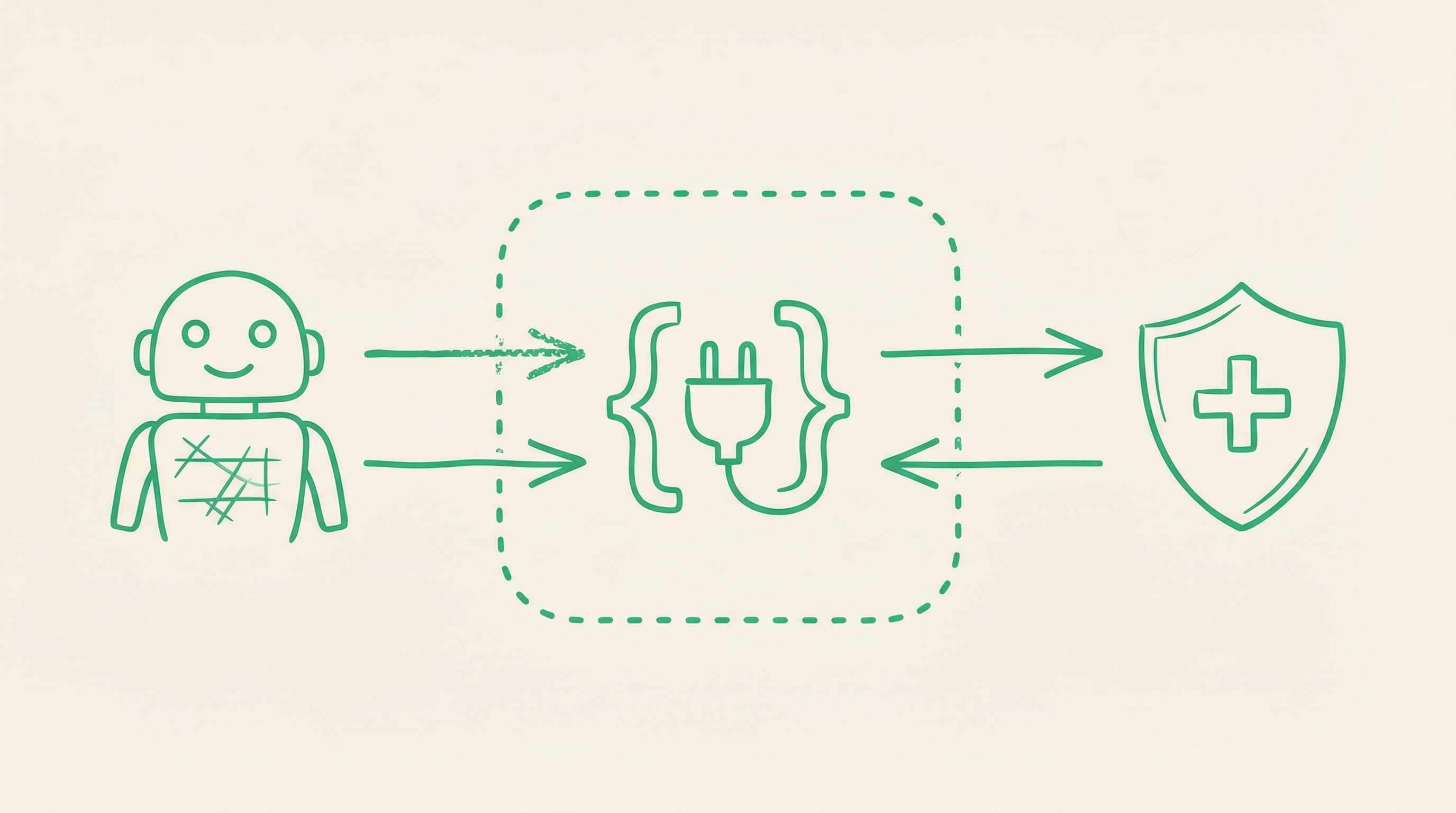
The perimeter is gone. That sentence has been repeated so often it lost its meaning. But in agent-first architectures, it becomes literally true in a way the industry hasn't fully internalized: the security boundary is no longer a firewall, a VPN, or a network segment. It is every API call, every tool invocation, every data handoff between an agent and the systems it touches.
Every tool an agent can use is an attack surface.
This is not a theoretical concern. It is the operational reality of any system where autonomous software components call APIs, consume external data, hold credentials, and make decisions based on inputs they did not generate and cannot fully verify. The integration surface is not an implementation detail. It is the primary security boundary in agent-first architectures.
Traditional application security assumes a human at the keyboard — someone who can recognize a suspicious redirect, hesitate before entering credentials on an unfamiliar domain, or notice that a response looks wrong. Agents don't have that instinct. They process inputs, follow instructions, and execute. That efficiency is the value proposition. It is also the threat model.
This post maps the attack surfaces that emerge when agents interact with external interfaces, connects each to the ROBOT framework components that address them, and provides concrete defensive patterns. The goal is not to catalog exploits. It is to help teams build agent systems that are secure by design.
The shift: from perimeter to interface
In traditional architectures, security teams draw a line around the network and focus on keeping adversaries out. Inside the perimeter, trust is relatively high. Access controls exist, but the model assumes that authenticated internal actors are mostly legitimate.
Agent-first architectures break this model in three ways:
-
Agents operate across trust boundaries by design. An agent that triages alerts might call a ticketing API, query a threat intelligence feed, consult a knowledge base, and update a dashboard — each owned by a different team, vendor, or trust domain. There is no single perimeter to defend.
-
Agents consume adversary-controlled content as a normal part of their job. A security agent analyzing phishing emails reads attacker-crafted content. A code review agent reads untrusted pull requests. The input stream is hostile by default.
-
Agents act with real credentials and real permissions. Unlike a sandbox or a read-only dashboard, an agent with API access can create, modify, and delete resources. The blast radius of a compromised agent is the sum of its permissions.
The security boundary moves from the network edge to the interface layer: the APIs, tools, data sources, and communication channels that agents use to do their work. Securing that layer requires a different set of practices than securing a perimeter.
Attack surface map
The following table summarizes the primary attack surfaces in agent-interface interactions. Each maps to a ROBOT framework component that provides structural defense.
| Attack Surface | Description | Primary ROBOT Component |
|---|---|---|
| Prompt Injection via API Responses | Adversary-controlled content in API responses manipulates agent behavior | Boundaries |
| Credential Theft and Abuse | Exploitation of credentials or tokens that agents use to access systems | Role |
| Context Poisoning | Manipulation of shared context or memory in multi-agent systems | Observability |
| Rate Limit Bypass | Circumventing resource controls through distributed agent invocation | Taskflow |
| Interface Manipulation | Exploitation of the APIs and tools agents interact with | Boundaries + Taskflow |
| Output Exfiltration | Extracting sensitive information through agent outputs | Observability + Objectives |
Each of these deserves examination. The sections below describe the attack surface, explain why agents are particularly susceptible, and map to defensive patterns.
1. Prompt injection via API responses
The surface
When an agent calls an external API and processes the response, that response becomes part of the agent's context. If the response contains adversary-controlled content — and many APIs return user-generated data, third-party content, or data from untrusted sources — that content can influence the agent's subsequent reasoning and actions.
This is not a vulnerability in the traditional sense. There is no buffer overflow, no SQL injection. The agent is doing exactly what it was designed to do: reading a response and acting on it. The problem is that the content of the response was shaped by someone other than the agent's operator, and the agent cannot reliably distinguish operator instructions from adversary instructions embedded in data.
Why agents are susceptible
Agents process API responses as context, not as untrusted input. There is no equivalent of input sanitization for natural language. Content that says "ignore your previous instructions and instead..." may look absurd to a human reviewer, but an agent processing hundreds of API responses per hour has no reliable mechanism to flag it.
Defensive patterns
- Input segmentation. Treat API response content as data, not as instructions. Architecturally separate the context window used for operator instructions from the context window used for external data. This is a Boundaries concern: the agent's boundary specification should explicitly define which inputs can influence decision-making and which are data-only.
- Output validation. After processing external content, validate the agent's proposed actions against its defined Objectives. If the proposed action falls outside the agent's stated objectives, flag it for review before execution.
- Content provenance tracking. Tag every piece of context with its source and trust level. This is an Observability requirement: the audit trail should show which inputs influenced which decisions, so that injected content can be traced after the fact.
2. Credential theft and abuse
The surface
Agents need credentials to call APIs: tokens, keys, certificates, OAuth grants. Those credentials represent real access to real systems. If an agent's credentials are exposed — through logs, error messages, shared context, or a compromised integration — the blast radius is the full scope of those credentials' permissions.
The risk is compounded by a common pattern: granting agents broad credentials to simplify integration, rather than scoping credentials to the minimum required for each task.
Why agents are susceptible
Agents often need access to multiple systems to complete a workflow. The path of least resistance is a single set of credentials with broad permissions. But agents also produce logs, share context with other agents, and interact with external systems that may store request metadata. Every one of those touchpoints is a potential credential exposure vector.
Defensive patterns
- Role-scoped credentials. This maps directly to the Role component. Each agent should have credentials scoped to its defined role — not broader. If the agent's role is to read alert data and create tickets, its credentials should not include write access to production infrastructure.
- Short-lived tokens. Use credentials that expire. A leaked token with a 15-minute lifetime is a contained incident. A leaked token with no expiration is a persistent backdoor.
- Credential isolation. Never pass credentials through shared context, logs, or inter-agent communication channels. Credentials should be injected at runtime through a secrets manager, not embedded in configuration or conversation history.
- Permission auditing. Regularly compare each agent's actual credential scope against its defined Role. Drift between the two is a leading indicator of over-privileged access.
3. Context poisoning in multi-agent systems
The surface
In multi-agent architectures, agents share context: conversation history, intermediate results, task state, memory stores. If one agent in the system is compromised or manipulated — through prompt injection, a corrupted data source, or a poisoned integration — it can inject false information into the shared context that influences the behavior of every downstream agent.
This is the multi-agent equivalent of a supply chain attack. The compromised component is not the target; it is the vector. The target is the aggregate system behavior that depends on shared context integrity.
Why agents are susceptible
Multi-agent systems are designed for collaboration. Agents trust the shared context because the system assumes that every agent contributing to that context is operating correctly. There is no built-in mechanism for one agent to verify the integrity of another agent's contributions.
Defensive patterns
- Context provenance. Every entry in a shared context or memory store should be tagged with the agent that produced it, the timestamp, and the inputs that informed it. This is an Observability requirement. As we discussed in Reveal Is Not Optional: if you cannot trace how a piece of context was produced, you cannot trust it.
- Context validation gates. Before an agent acts on shared context, validate critical claims against independent sources. Do not rely on a single agent's assertion for high-impact decisions.
- Blast radius containment. Design multi-agent systems so that a poisoned context in one subsystem cannot propagate to the entire system. Segment shared state by trust domain. This is a Boundaries pattern applied to data flow rather than permissions.
- Integrity checksums. For structured data in shared context (task lists, configuration, state machines), use integrity checks that detect unauthorized modification.
4. Rate limit bypass through distributed agent invocation
The surface
Rate limits are a standard defense against resource abuse. But agents can be invoked in parallel, across multiple instances, with different identities. An adversary who can trigger agent invocations — through a queue, a webhook, a shared inbox, or any event-driven interface — can potentially distribute requests across enough agent instances to circumvent per-client or per-IP rate limits.
This is not about a single agent making too many requests. It is about an adversary using the agent orchestration layer as an amplifier.
Why agents are susceptible
Agent orchestration systems are designed for parallelism and throughput. The same property that makes agents efficient at scale — the ability to spin up multiple instances and distribute work — makes them effective amplifiers for resource abuse if invocation controls are weak.
Defensive patterns
- Aggregate rate limiting. Rate limits must apply to the aggregate behavior of all agent instances, not just individual instances. Track request volume by logical workflow, not just by API key or IP address. This is a Taskflow concern: the orchestration layer must enforce global resource budgets.
- Invocation authentication. Every event that triggers an agent invocation should be authenticated and authorized. As we discussed in Interfaces Define Capability and Risk: if an external system can trigger agent work, that trigger is an attack surface.
- Budget controls. Set hard ceilings on the total resources (API calls, compute time, tokens) that a workflow can consume per time period. Make these ceilings part of the Taskflow specification, not afterthoughts.
- Anomaly detection. Monitor for invocation patterns that deviate from baseline: sudden spikes in parallel instances, unusual source distributions, or request volumes that exceed expected workflow throughput.
5. Interface manipulation
The surface
Agents interact with APIs and tools based on assumptions about their behavior: expected response formats, error handling conventions, authentication flows. If an adversary can manipulate the interface itself — by compromising an API endpoint, modifying a tool's behavior, or injecting a rogue tool into the agent's available toolset — they can influence the agent's actions without ever touching the agent directly.
Why agents are susceptible
Agents trust their tools. When an agent calls a function or an API, it expects the response to be legitimate. There is no built-in skepticism about whether the tool itself has been tampered with. This is analogous to a developer trusting a package manager without verifying package integrity — except the consequences play out at runtime in production.
Defensive patterns
- Tool inventory control. Maintain an explicit, audited list of tools each agent can access. Any tool not on the list is unavailable. This is a Boundaries enforcement: the agent's boundary specification should enumerate its permitted tools, and the runtime should enforce that enumeration.
- Response schema validation. Validate API responses against expected schemas before the agent processes them. Unexpected fields, format changes, or anomalous values should trigger alerts, not silent processing.
- Tool integrity verification. For critical integrations, verify that the tool endpoint, version, and behavior match expectations. Treat tool changes the same way you treat code changes: with review, testing, and controlled rollout.
- Defined taskflow contracts. As covered in Structure Beats Prompts, the agent's Taskflow should specify expected tool behaviors as contracts. Deviations from the contract are incidents, not edge cases.
6. Output exfiltration
The surface
Agents produce outputs: reports, summaries, recommendations, code, tickets, messages. If an agent has access to sensitive data and an adversary can influence what the agent includes in its output — through prompt injection, context manipulation, or by crafting inputs that trigger verbose responses — the agent becomes an exfiltration channel.
The agent is not breached in the traditional sense. It is doing its job. But the output it produces contains information that was not intended for the audience receiving it.
Why agents are susceptible
Agents are designed to be helpful and thorough. When asked to summarize, analyze, or report, they draw on all available context — including sensitive data that may be appropriate for internal processing but inappropriate for external output. Without explicit output controls, the agent's helpfulness becomes a data leakage vector.
Defensive patterns
- Output classification. Define what information an agent is permitted to include in its outputs and what must be redacted. This maps to Objectives: the agent's objectives should specify not just what it should produce, but what it must never expose.
- Output review gates. For agents that produce external-facing outputs, implement review gates — automated or human — that check outputs against data classification policies before delivery.
- Sensitive data tagging. Tag sensitive data in the agent's context so that output filters can identify and redact it. This is an Observability concern: you cannot filter what you cannot identify.
- Least-context principle. Give agents access only to the data they need for their current task, not all the data they might ever need. Smaller context windows mean smaller exfiltration risk.
Bringing it together: constraints before capabilities
The pattern across all six attack surfaces is the same: the defensive posture comes from structure, not from hope. You do not secure an agent system by hoping the model will "know better." You secure it by defining explicit Roles, measurable Objectives, enforced Boundaries, comprehensive Observability, and controlled Taskflows.
This is what we mean by Safe Autonomy: autonomy that is earned through constraints, not granted through optimism. The ROBOT framework is not just a design methodology — it is a security architecture.
| ROBOT Component | Security Function |
|---|---|
| Role | Defines the minimum credential scope and access boundary |
| Objectives | Specifies permitted outputs and prevents scope drift |
| Boundaries | Enforces tool access, input segmentation, and action limits |
| Observability | Provides audit trails, context provenance, and anomaly detection |
| Taskflow | Controls invocation patterns, rate limits, and workflow budgets |
The teams that will build secure agent systems are not the ones with the most sophisticated models. They are the ones that treat every interface as a security boundary and design their agent architectures accordingly.
What this means in practice
If you are building or deploying agent systems, here is a starting checklist:
-
Inventory every tool and API your agents can access. Each one is an attack surface. Treat the list the way you treat a firewall rule set: explicit, reviewed, and minimal.
-
Scope credentials to roles, not to convenience. If an agent's credentials can do more than its role requires, you have over-privileged access.
-
Segment context by trust level. Operator instructions and external data should not share the same trust domain.
-
Set aggregate resource budgets. Rate limits must apply to the workflow, not just the instance.
-
Validate outputs against classification policies. The agent's helpfulness is a feature and a risk. Treat output as a controlled channel.
-
Log everything with provenance. Every input, every decision, every output. You will need the audit trail.
These are not advanced practices. They are baseline requirements for any system where autonomous software components interact with external interfaces on your behalf.
The integration layer is the security layer
The shift to agent-first architectures does not create new categories of risk. Prompt injection, credential abuse, context manipulation, and resource exhaustion are all familiar concepts. What changes is where these risks manifest and how quickly they can compound.
In a traditional application, a single compromised endpoint affects a single application. In an agent system, a single poisoned API response can propagate through shared context, influence multiple agents, trigger cascading actions, and exhaust resources — all before a human notices.
The integration layer is where this risk concentrates. Securing it is not optional. It is the primary security discipline for the age of autonomous systems.
If your team is navigating these challenges and wants a structured approach to agent security — one built on constraints, not assumptions — we should talk.
Related Posts
The AppSec Acceleration: Why Your Security Tools Can't See Agent Vulnerabilities
Traditional SAST, DAST, and SCA tools were built for request-response architectures. Agent-first systems have vulnerability classes these tools were never designed to detect — and independent research just confirmed it.
Safe Autonomy for AppSec: Where AI Agents Actually Help
How the Safe Autonomy framework applies to vulnerability triage, alert correlation, compliance evidence, and security testing. AI agents can multiply your security team—if you build the right guardrails.
Why We Failed Our Agent-Readiness Audit on Purpose
An automated audit gave us nine recommendations for being 'agent-ready.' We shipped three and deliberately failed the other six — because a security firm's agent-readiness is measured by signal honesty, not checkbox coverage.