Structure Beats Prompts: ROBOT in the Wild
Updated June 21, 2026
Series: Safe Autonomy in the Real World (5 parts)
- Safe Autonomy in the Real World: 4 Lessons
- Takeaway A: Reveal Is Not Optional
- Takeaway B: Structure Beats Prompts ← You are here
- Takeaway C: Interfaces Define Capability and Risk
- Takeaway D: Accountability Stays Human
Two teams can use the same model and get radically different outcomes.
One ships value. One ships chaos.
The difference is rarely “prompt quality.” The difference is structure.
You're not deploying a model. You're deploying a workflow system.
1) The problem (unstructured autonomy becomes overhead)
When an agent is unstructured, every run is a new adventure:
- decisions drift
- context gets lost
- handoffs get invented
- stop conditions disappear
Humans respond with more process: more approvals, more checklists, more manual review. Not because they're anti-autonomy — because they're pro-survival.
When structure is missing, humans become the structure.
2) The case study (what the live trial highlighted)
In a published live-environment evaluation, different agent scaffolds produced meaningfully different outcomes under the same high-level goal.
Source: https://arxiv.org/abs/2512.09882
Evidence points (kept abstract on purpose):
- scaffold differences drove performance differences
- the successful scaffold included a supervisor/planner layer, specialist sub-agents, explicit triage, and long-horizon context/session management
That isn't a prompt trick. It's architecture. Recent research backs this up quantitatively: Song et al. found that API-based web agents achieved roughly 2x the success rate of GUI-only agents on the WebArena benchmark — with API agents completing tasks in 3 lines of code where GUI agents failed after 15+ steps (ACL Findings, 2025).
Predictability doesn't come from cleverness. It comes from constraints and flow.
3) The takeaway (B) stated plainly
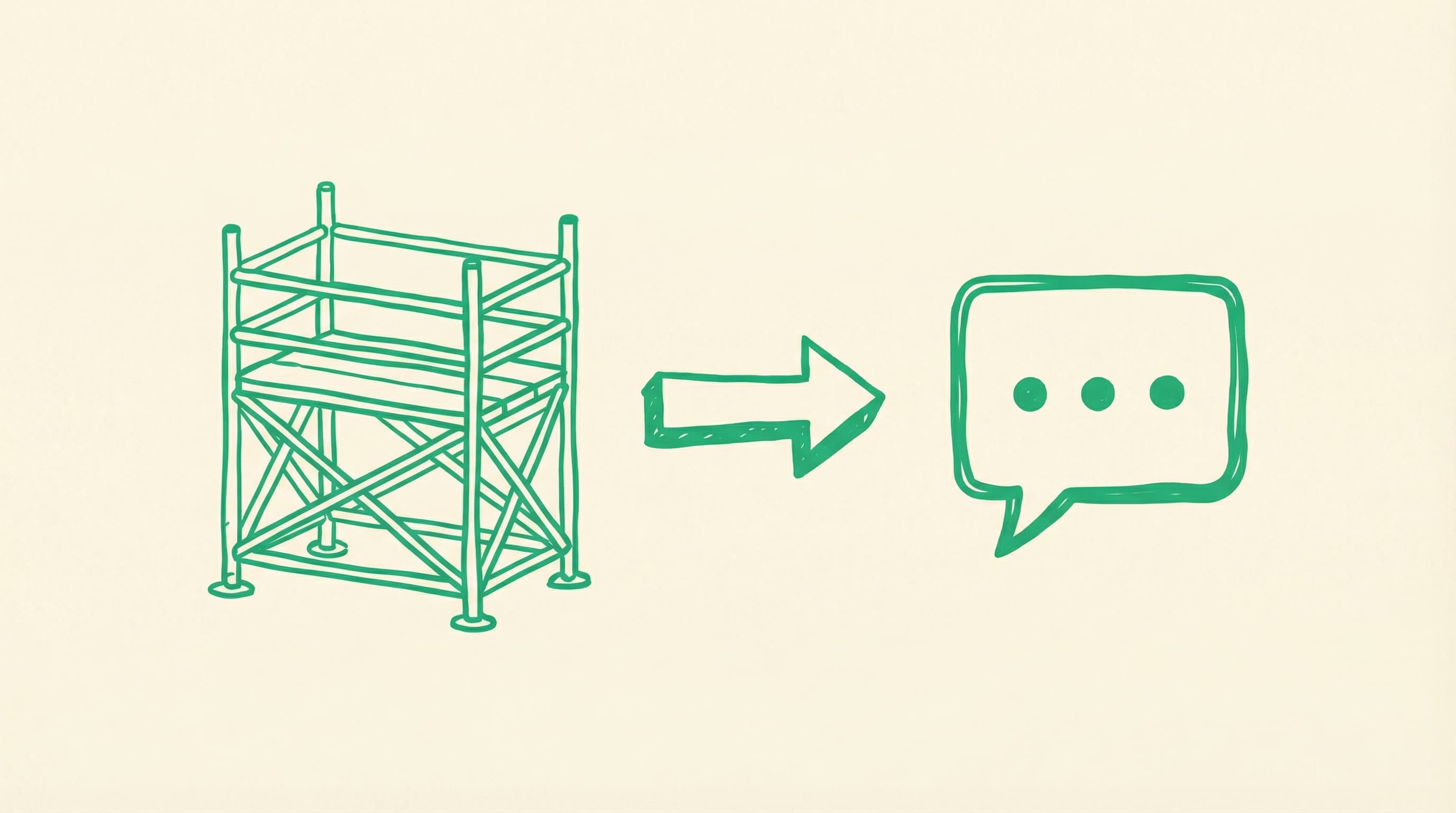
Scaffolding is the product. Predictability comes from structure: roles, objectives, boundaries, observability, and taskflow.
This is why we use ROBOT as a design spec for production-ready agentic workflows.
4) What this changes in practice
ROBOT mapping (the deployable-agent checklist)
- Role: separate planner (supervisor) from doers (specialists/sub-agents)
- Objectives: define measurable outcomes (quality, speed, safety), not “be helpful”
- Boundaries: explicit scope rules and forbidden actions; enforce at runtime
- Observability: logs, traces, intermediate artifacts, decision history
- Taskflow: repeatable SOPs, handoffs, stop criteria, sessioning for long-horizon work
Patterns
Minimum viable scaffold
If you want a fast test for whether an “agent” is a system or a demo, look for:
- state (todo/notes) that survives steps
- retries with visible reasons (not silent loops)
- escalation paths (who/when it hands off)
- audit logs (inputs, decisions, actions)
- rollback paths (how to undo)
- stop conditions (when it must halt)
Evaluate the system, not the demo
Production readiness looks like:
- runbooks for normal and failure modes
- reproducible runs (a human can replay the logic)
- failure-mode testing (what happens under partial info, broken integrations, conflicting signals)
Validate inputs at trust boundaries
Agents must distinguish trusted from untrusted input:
Trust boundaries:
- System prompts and configurations: trusted
- User input and external data: untrusted
- API responses from tools: validate before use
Validation patterns:
- Never interpolate untrusted input into system prompts without sanitization
- Validate all external data before agent processing
- Log all input sources for forensic analysis
Input validation anti-patterns:
- Treating user input as trusted by default
- Embedding untrusted data directly in prompts
- Assuming tool responses are always well-formed
The boundary between trusted and untrusted input is where most agent vulnerabilities live.
Anti-patterns
The data on unstructured automation reinforces the point: up to 50% of initial RPA projects fail according to Ernst & Young research, largely because of brittle UI-dependent scripts and poor process understanding. Structure isn't optional — it's the difference between compounding value and compounding debt.
- prompt-only "agents" with no state, no logs, no boundaries, no stop conditions
- single-loop agents for long-horizon workflows (context loss → drift)
- “autonomy” that can't be audited, replayed, or improved systematically
Metrics
- task completion quality (pass/fail + reviewer confidence)
- drift rate (off-task or boundary pressure)
- reproducibility rate (can a human replay the run)
- mean time to detect and stop a bad run
5) Bottom line + blocks
Recap:
- Structure is what turns capability into reliability.
- Supervisor + specialists + triage is a governance pattern, not a buzzword.
- ROBOT is the minimum spec for predictable agentic workflows.
- The goal isn't to avoid failures — it's to make failures detectable, explainable, and containable.
Series: Safe Autonomy in the Real World (5 parts)
- Safe Autonomy in the Real World: 4 Lessons
- Takeaway A: Reveal Is Not Optional
- Takeaway B: Structure Beats Prompts ← You are here
- Takeaway C: Interfaces Define Capability and Risk
- Takeaway D: Accountability Stays Human
This series uses a published cybersecurity study as a real-world case study to extract general lessons about safe autonomy and agentic workflows. It is not instructions for unauthorized activity, and it is not legal, compliance, or security advice.
If this series resonates with how you think about safe autonomy, we should talk.
Related Posts
Your Token Budget Is a Security Control
Most teams treat token spend limits as cost management. They are blast radius containment. An autonomous agent with no spending ceiling is not a productivity tool — it is an uncontrolled liability.
The AppSec Acceleration: Why Your Security Tools Can't See Agent Vulnerabilities
Traditional SAST, DAST, and SCA tools were built for request-response architectures. Agent-first systems have vulnerability classes these tools were never designed to detect — and independent research just confirmed it.
Palantirization and Safe Autonomy: The Same Bet
The trap a16z identified for FDE-model startups is identical to the trap facing AI agent deployments.