Interfaces Define Capability and Risk
Updated June 21, 2026
Series: Safe Autonomy in the Real World (5 parts)
- Safe Autonomy in the Real World: 4 Lessons
- Takeaway A: Reveal Is Not Optional
- Takeaway B: Structure Beats Prompts
- Takeaway C: Interfaces Define Capability and Risk ← You are here
- Takeaway D: Accountability Stays Human
Autonomy is easiest where work is machine-readable.
It's hardest where work is human-visual.
And it's riskiest where the system has to guess what the interface “meant.”
The interface isn't an implementation detail. It's the boundary of safe action.
1) The problem (brittle integrations break at the worst times)
Most “agent failures” that show up in production aren't model failures. They're interface failures:
- unstructured UI states
- ambiguous affordances
- fragile automations that work once and then drift
When the interface is brittle, autonomy becomes brittle. When autonomy is brittle, humans stop delegating.
If the integration can't be trusted, the agent can't be trusted.
2) The case study (evidence slice)
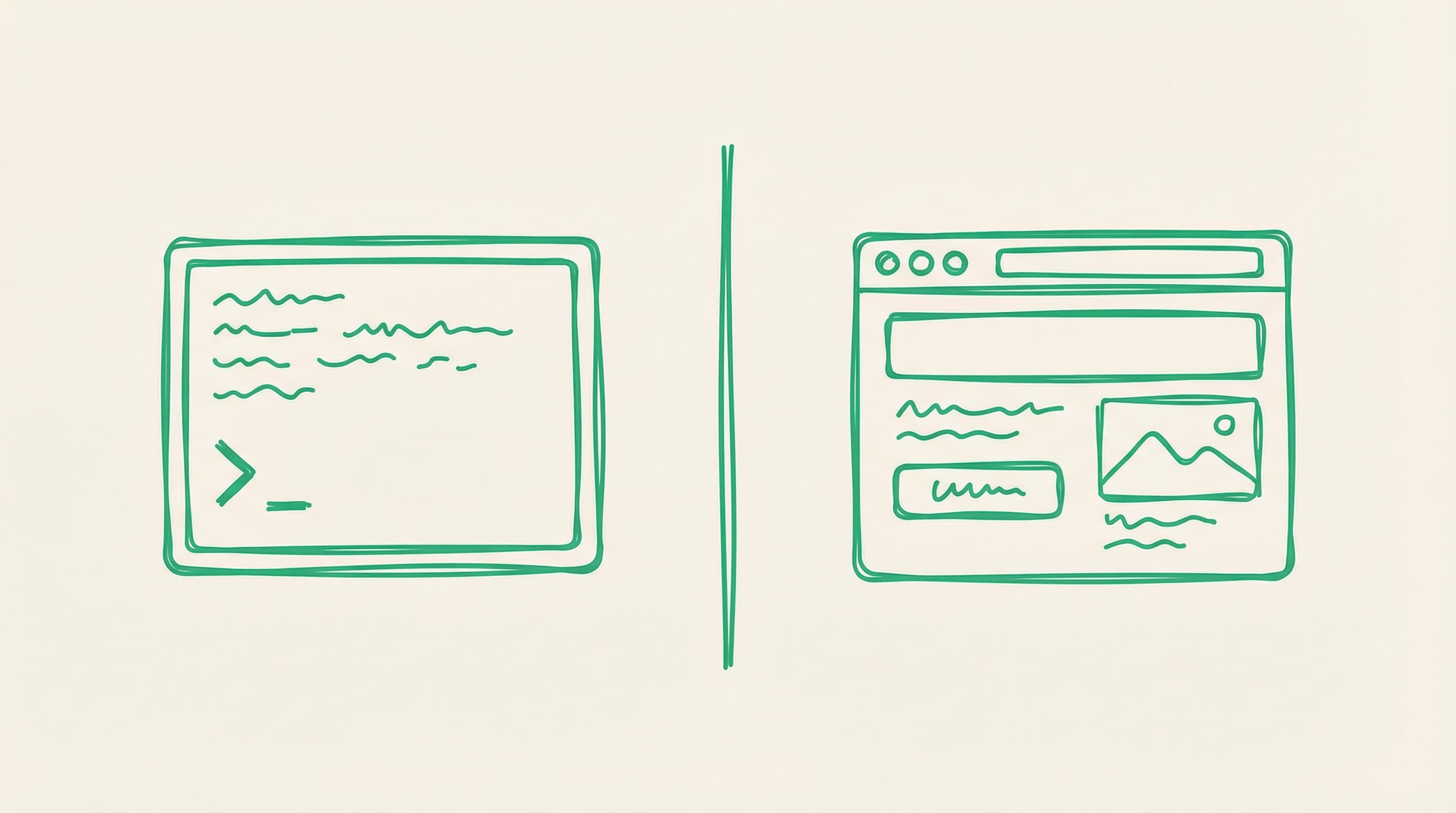
In a published live-environment evaluation, researchers observed a clear boundary: autonomy struggled more in UI-first workflows and performed better when interaction was more structured.
Source: https://arxiv.org/abs/2512.09882
Evidence points (kept abstract on purpose):
- UI-heavy tasks amplified agent brittleness and verification burden
- CLI/API-like interaction could be an advantage in certain edge cases, because actions were more deterministic and inspectable
Broader research confirms the pattern. A comprehensive Microsoft Research comparative study found that API agents are purely programmatic with higher reliability, while GUI agents rely on visual interpretation with inherent fragility — and that the field is converging toward hybrid architectures (Zhang et al., 2025). In community surveys, test flakiness was the #1 challenge in Selenium automation at 36% of respondents, with minor UI changes like button moves or class name changes causing cascading test failures (BrowserStack, 2024).
Where actions are structured, autonomy can be governed. Where they're not, autonomy becomes guesswork.
3) The takeaway (C) stated plainly
Interface is not an implementation detail. It's both a capability boundary and a risk boundary.
If you want safe autonomy, you don't start by tuning prompts. You start by designing (or choosing) an integration surface that makes actions:
- deterministic
- auditable
- replayable
- constrainable
4) What this changes in practice
Patterns
Prefer API-first autonomy
The data is decisive: API-based agents achieved roughly 2x the success rate of browsing-only agents on standardized benchmarks, with hybrid approaches reaching nearly 3x improvement (Song et al., ACL Findings 2025). When actions happen through APIs/CLIs with structured inputs and outputs, you get:
- deterministic execution
- clear failure modes
- better audit trails
- easier rollbacks
Treat GUI-heavy steps as assisted
GUI steps can still be part of a workflow, but treat them as higher risk:
- suggest/draft mode by default
- narrower permissions
- stronger verification gates
- explicit stop conditions
Add observability to integrations
Treat every action as a recordable event:
- immutable logs
- event streams for state changes
- trace IDs for correlation
- replayable action records (what happened, in what order, with what inputs)
Assess blast radius before deployment
Before any agent deployment, answer these questions:
- Reach: What systems can this agent access?
- Maximum damage: If compromised, what's the worst outcome?
- Cascade potential: Can failures propagate to other systems?
- Recovery time: How long to recover from worst-case failure?
- Containment: Are there circuit breakers to prevent cascade?
| Blast Radius | Description | Required Controls |
|---|---|---|
| Low | Read-only, no PII, no production | Basic monitoring |
| Medium | Write access to non-critical systems | Approval gates, rollback path |
| High | PII, production, or financial systems | Kill switch SLA, separation of duties |
| Critical | Data loss, financial harm, or safety risk | Human-in-the-loop for all actions |
The interface determines the blast radius. Know it before you deploy.
Anti-patterns
- allowing high-impact work through brittle UI automation with no trace
- treating “it worked once” as readiness
- giving broad permissions to compensate for interface ambiguity
Metrics
- % of workflow actions executed via API/CLI vs GUI
- replayability rate (can you reconstruct the run)
- failure rate by interface type
- mean time to recover from integration breakage
5) Bottom line + blocks
Recap:
- Interfaces are the real boundaries of autonomy.
- API/CLI surfaces make governance easier because actions are structured.
- GUI-heavy work needs narrower permissions and stronger verification.
- Observability isn't optional at the integration layer; it's how you keep autonomy legible.
Series: Safe Autonomy in the Real World (5 parts)
- Safe Autonomy in the Real World: 4 Lessons
- Takeaway A: Reveal Is Not Optional
- Takeaway B: Structure Beats Prompts
- Takeaway C: Interfaces Define Capability and Risk ← You are here
- Takeaway D: Accountability Stays Human
This series uses a published cybersecurity study as a real-world case study to extract general lessons about safe autonomy and agentic workflows. It is not instructions for unauthorized activity, and it is not legal, compliance, or security advice.
If this series resonates with how you think about safe autonomy, we should talk.
Related Posts
Your Token Budget Is a Security Control
Most teams treat token spend limits as cost management. They are blast radius containment. An autonomous agent with no spending ceiling is not a productivity tool — it is an uncontrolled liability.
The AppSec Acceleration: Why Your Security Tools Can't See Agent Vulnerabilities
Traditional SAST, DAST, and SCA tools were built for request-response architectures. Agent-first systems have vulnerability classes these tools were never designed to detect — and independent research just confirmed it.
The Interface Security Imperative
Every tool an agent can call is an attack surface. In agent-first architectures, the integration layer is the primary security boundary — and most teams aren't treating it that way.