Agents, Accountability, and the Corporate Reality
Updated June 21, 2026
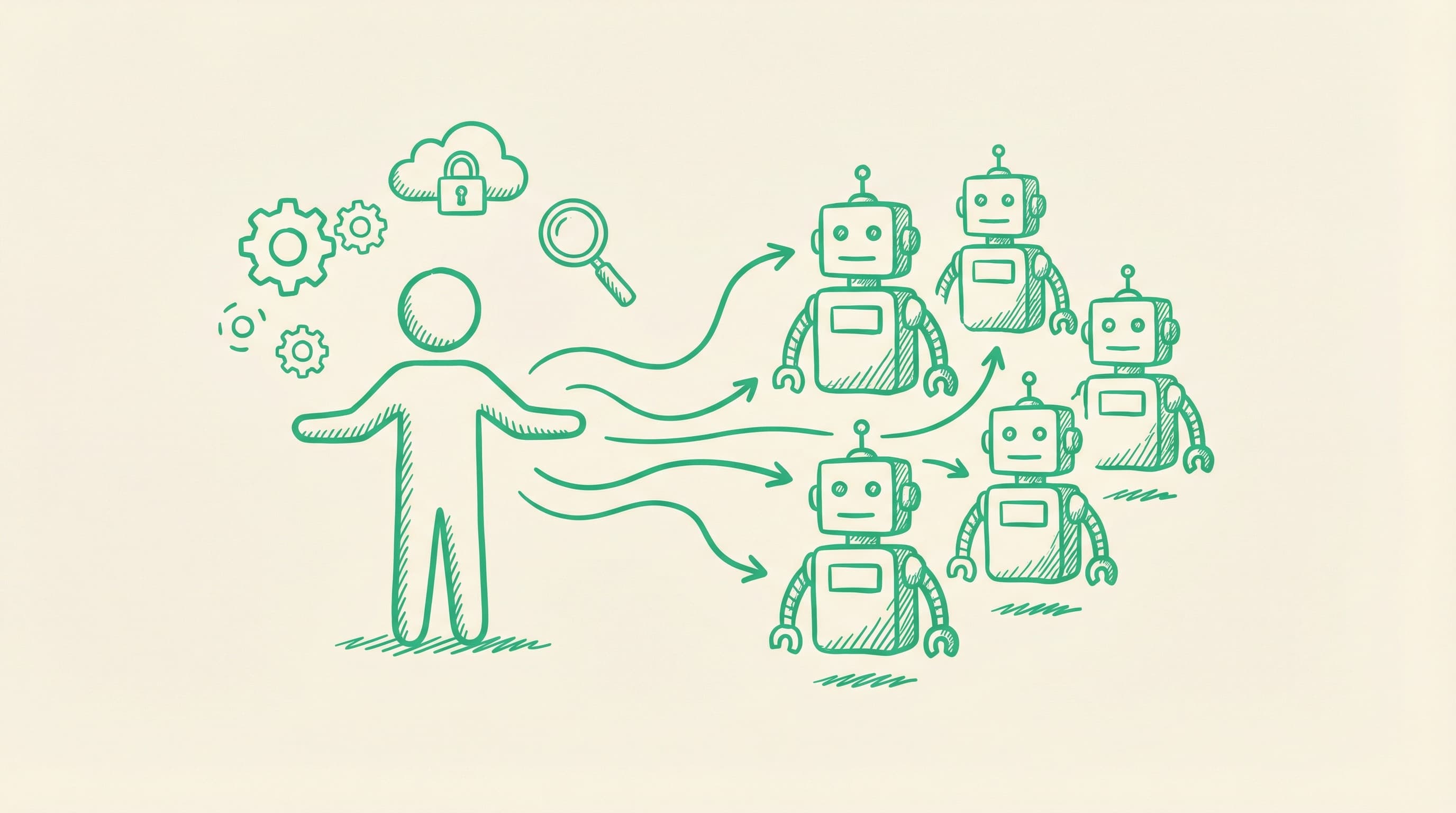
Everyone is excited about agentic AI right now. Autonomous workflows, embedded decision-making, systems that "just run themselves."
But amid all the talk about capability and productivity, we're skipping over the question enterprises actually revolve around:
Who is responsible when the agent acts?
Enterprises don't fear autonomy. They fear unowned action.
That question isn't optional in a corporate environment. It's foundational.
Companies don't hire people for labor — they hire them for liability
There's a popular idea that AI will replace human labor because it can do many tasks better or faster.
But most enterprises don't hire humans to type faster or compute better. They hire them because humans can accept responsibility.
Humans aren't kept around because they do the work. They're kept around because they can take the blame.
This is not cynicism. It's organizational physics.
Work gets done, but accountability is what keeps the system coherent. AI doesn't change that.
Agents are a new kind of infrastructure
AI agents don't behave like anything we've had before.
They aren't employees. They aren't cron jobs. They aren't microservices.
They're something in between: autonomous operational components that act with flexibility but can't represent intent or absorb consequences.
Agents can act. They just can't answer for their actions.
That mismatch is where governance tension begins.
The accountability proxy: every agent needs a human behind it
If an agent is allowed to take actions in an enterprise environment, someone must be the endpoint of responsibility for those actions.
That human:
- defines the agent's role
- scopes its permissions
- sets its operating boundaries
- becomes the escalation path
- takes the hit when something goes wrong
The agent executes the work. The human absorbs the risk.
An agent's authority is borrowed. The debt is paid by the human who deploys it.
This isn't about supervising AI. It's about completing the accountability circuit that enterprise systems require to function.
The hidden economy of corporate blame
Every enterprise runs on an unwritten principle:
Every action must map to a person.
You never see this on an architecture diagram, but it governs all work.
When something breaks, the first question isn't "What happened?" It's "Who approved this?" and "Who is accountable?"
If no human owns the decision, the decision cannot exist.
This is how organizations manage risk. It's why humans don't disappear when automation increases — they become more essential.
Autonomy doesn't reduce responsibility — it concentrates it
It's tempting to think that as agents become more capable, humans become less necessary.
The opposite is true.
In practice, agents fall into intuitive buckets:
- Task automators — simple, contained, low-risk
- Task performers — domain decisions, meaningful consequences
- Operational actors — cross-system coordination, large blast radius
And here's the part people gloss over:
The more an agent can decide, the more a human must be accountable.
Autonomy scales output. It also scales the cost of mistakes — and only humans can absorb that cost.
Compliance: the gravity well that pulls everything back to humans
Compliance frameworks — SOC 2, SOX, ISO, GDPR — all share a single assumption:
A named human is responsible for every material action inside the system.
This is not abstract. GDPR Article 22 gives individuals the right not to be subject to decisions based solely on automated processing, and requires organizations to provide meaningful human intervention — not rubber-stamp review. ISO/IEC 42001 requires organizations to name specific individuals with documented authority and operational power to intervene in live AI systems. The EU AI Act (effective 2024, with high-risk obligations applying August 2026) mandates human oversight for high-risk AI systems, with fines up to 35 million euros or 7% of global turnover.
AI cannot:
- sign an attestation
- be interviewed by an auditor
- demonstrate intent
- accept fault
- be terminated for negligence
So responsibility flows back to the people who deploy, authorize, or benefit from the agent's actions. Courts are already enforcing this. In Moffatt v. Air Canada (2024), Air Canada argued its chatbot was a "separate legal entity" — the tribunal called this "a remarkable submission" and held the company liable. In Mobley v. Workday (2024), a federal court applied agency theory to hold an AI vendor directly liable for discriminatory hiring decisions.
Compliance doesn't care who acted. It cares who can be held accountable.
Agents don't change this gravity. They orbit it.
Why humans aren't going anywhere
Agents can execute work. Humans must own the work.
Agents reduce the amount of human doing. They increase the importance of human accountability.
Enterprises will always need people who can:
- justify trade-offs
- accept consequences
- represent organizational intent
- shield leadership from risk
These aren't optional functions. They are the backbone of corporate governance.
A final, slightly provocative note
Agents will transform how work gets done. But they won't transform who companies rely on to bear the weight of risk.
Autonomy doesn't eliminate responsibility. It concentrates it.
Organizations that deploy agents without attaching them to real human accountability structures aren't innovating — they're gambling.
And eventually something will go wrong.
When it does, the question will come:
"Who let this agent act without someone willing to stand behind it?"
If no one can answer, the problem isn't the agent.
It's the organization.
Related Posts
Accountability Stays Human: The Accountability Proxy
Autonomy concentrates responsibility. Here’s why every agent needs a named human owner and runtime governance controls.
The ROBOT Framework: A Practical Model for Building Production-Ready Agentic Workflows
A lightweight, enterprise-grade framework for designing safe, predictable, auditable agentic systems. Learn how Role, Objectives, Boundaries, Observability, and Taskflow turn ad-hoc automation into reliable operational workflows.
Autonomy Is Not an Alibi
Between October 1 and 8, a proposed Senate bill, the Wikimedia Foundation and the UK's data regulator all put AI agent operators on notice. Whoever runs an agent answers for what it does to everyone else.