AI Executes. Humans Own It.
Updated June 21, 2026
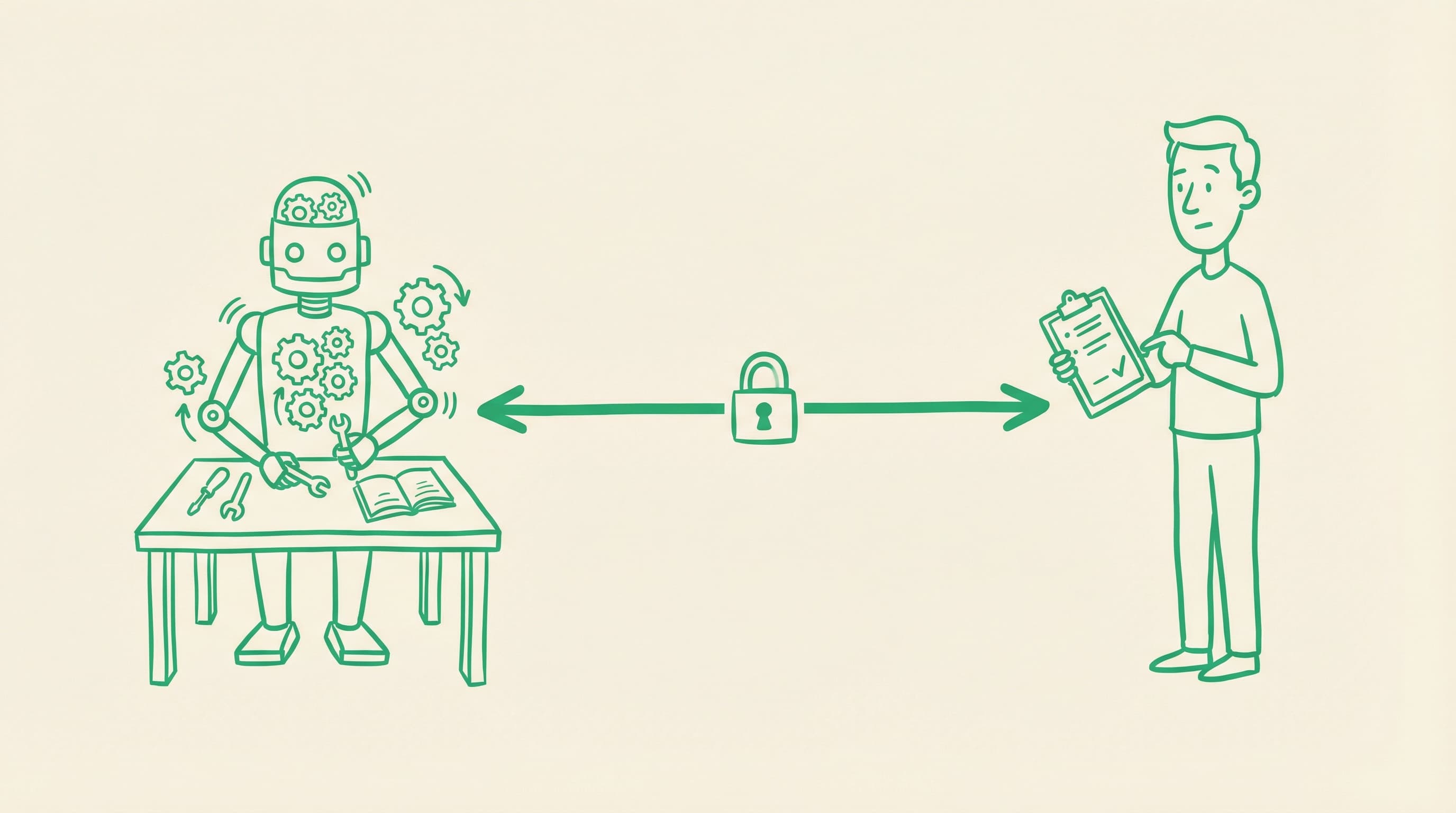
Two arguments about AI and work have been running in parallel, and most people only hear one of them.
The first says AI will handle the execution layer. All of it. The second says humans aren't going anywhere — because organizations need someone to be accountable.
Both are correct. And the interesting part isn't either argument on its own. It's what the architecture looks like when you accept both at the same time.
The execution case
The argument for AI displacing knowledge work execution is not theoretical anymore. It's operational.
Daniel Miessler's "Why AI Will Replace Knowledge Workers" (Unsupervised Learning, March 2026) makes the case bluntly: the bar AI needs to clear is remarkably low because most organizations operate in pervasive disorder. SOPs are fragmented. Tribal knowledge lives in people's heads and evaporates when they leave. Gallup's data shows only 21% of workers globally are engaged — 62% do the minimum, and 15% actively work against their own companies. Output quality is wildly inconsistent across individuals doing the same job.
In this environment, even a "decent" AI — uncreative but consistent — outperforms the average knowledge worker on commodity tasks. And McKinsey's own research found that only 4% of US work activities require creativity at median human level. The remaining 96% is commodity execution — processable, repeatable, automatable.
His proposed solution is the Lattice Architecture — a unified data system with tiered context (company, department, team, individual), permissioned agent gateways, and real-time queryability. Goals, SOPs, metrics, and work quality become retrievable in seconds. Visual workflows replace opaque processes. The company transforms from a black box into an observable pipeline.
The bar for AI to outperform human execution isn't high. In most organizations, it's on the floor.
If you stop here, the conclusion seems obvious: replace the execution layer with agents and reduce headcount.
But it's only half the picture.
The accountability case
We wrote about this in December 2025: Agents, Accountability, and the Corporate Reality.
The core claim was simple. Companies don't hire people for labor. They hire them for liability.
Humans aren't kept around because they do the work. They're kept around because they can take the blame.
Every enterprise runs on an unwritten principle: every action must map to a person. When something breaks, the first question isn't "what happened?" — it's "who approved this?" Compliance frameworks — SOC 2, GDPR, ISO 42001, the EU AI Act — all assume a named human is responsible for every material action inside the system.
AI agents can execute work. They cannot sign attestations. They cannot be interviewed by auditors. They cannot accept fault. They cannot be terminated for negligence.
So the accountability circuit requires a human to complete it. We called this the accountability proxy — a named owner who defines the agent's role, scopes its permissions, sets its boundaries, and takes the hit when something goes wrong.
An agent's authority is borrowed. The debt is paid by the human who deploys it.
If you stop here, the conclusion seems reassuring: humans are safe because organizations need someone to blame.
But it's also only half the picture.
The complete architecture
The execution case and the accountability case aren't in tension. They're describing two layers of the same system.
Layer 1: Execution. AI agents handle workflows — processing, coordinating, producing, reporting. The Lattice makes this transparent and queryable. Consistency replaces variance. Tribal knowledge becomes codified context. The 95% of work that is commodity gets automated.
Layer 2: Accountability. Humans own the consequences. Every agent maps to an accountability proxy. Every autonomous action traces back to a person who authorized its scope, monitored its behavior, and can answer for its output.
This isn't "AI replaces humans" or "humans supervise AI." It's a structural separation:
Agents do the work. Humans carry the weight.
The Lattice Architecture gives agents the context and infrastructure to execute reliably. The accountability proxy gives organizations the governance structure to deploy those agents without creating unowned risk.
Neither layer works without the other. Execution without accountability is a liability bomb. Accountability without execution is the status quo — the soup sandwich of inconsistent processes, tribal knowledge, and 21% engagement that Miessler describes.
And the execution shift is a ratchet — it only turns one way. Every process codified into a skill, every SOP captured, every piece of tribal knowledge documented stays in the pool permanently. Human expertise takes decades to build and walks out the door with every resignation. AI expertise compounds forever. The longer you wait to build the accountability layer, the wider the gap grows.
What this means in practice
If you're deploying AI agents in your organization, you're building this architecture whether you realize it or not. The question is whether you're building both layers or only one.
Signs you've built execution without accountability:
- Agents take actions and no named human owns the outcome
- No kill-switch exists for autonomous workflows
- You can't answer "who approved this?" for any agent action
- Compliance asks about your AI governance and you improvise
Signs you've built accountability without execution:
- You have governance policies but agents aren't actually doing the work
- Humans are still manually executing commodity tasks "because we need oversight"
- Your SOPs exist in scattered documents that no system can query
- You're paying for consistency you're not getting
The organizations that move fastest will be the ones that build both layers simultaneously — automating execution while hardening accountability. Not one then the other. Both, from the start.
The shift
The human role in organizations is changing. Not disappearing — concentrating.
Miessler calls the new human function "origination" — defining what should be done, why it matters, which problems to solve. We call it the accountability proxy — owning the consequences of what agents do.
These are the same role described from different angles. The originator decides the direction. The accountability proxy bears the cost if the direction is wrong. In practice, it's one person doing both.
AI doesn't eliminate the need for humans. It clarifies what humans are actually for.
The future org chart has fewer people doing more consequential work. Each person owns more scope, carries more responsibility, and delegates more execution to agents that operate within governed boundaries.
This is the architecture. Execution and accountability, separated cleanly, operating together.
Build both layers. Or don't deploy agents at all.
If you're building both layers and want a second opinion on the architecture, we should talk.
Related Posts
Autonomy Is Not an Alibi
Between October 1 and 8, a proposed Senate bill, the Wikimedia Foundation and the UK's data regulator all put AI agent operators on notice. Whoever runs an agent answers for what it does to everyone else.
Accountability Stays Human: The Accountability Proxy
Autonomy concentrates responsibility. Here’s why every agent needs a named human owner and runtime governance controls.
The Guardrails Belong to Whoever Runs It
An open-source AI pentest platform that now promises "governed execution" turned up on infrastructure tied to more than 600 compromised FortiGate devices. The governing is done by whoever runs it, and that's true of your agents too.